Why an Elevation Audit Matters Before Siding Patch Repairs
On commercial buildings, siding damage is rarely just a single visible spot. A cracked panel, stained seam, loose trim board, or soft area may be the first sign of a larger issue across the wall assembly. That is why a siding elevation audit should come before approving patch repairs.
For property managers, owners, and tenant-occupied buildings in Portland and the Portland Metro area, the goal is simple: understand what is happening on the full elevation before spending money on a localized repair. A focused audit helps identify whether a patch is appropriate, whether moisture is moving behind the cladding, and whether siding replacement should be considered for part or all of the wall.
What Is a Commercial Siding Elevation Audit?
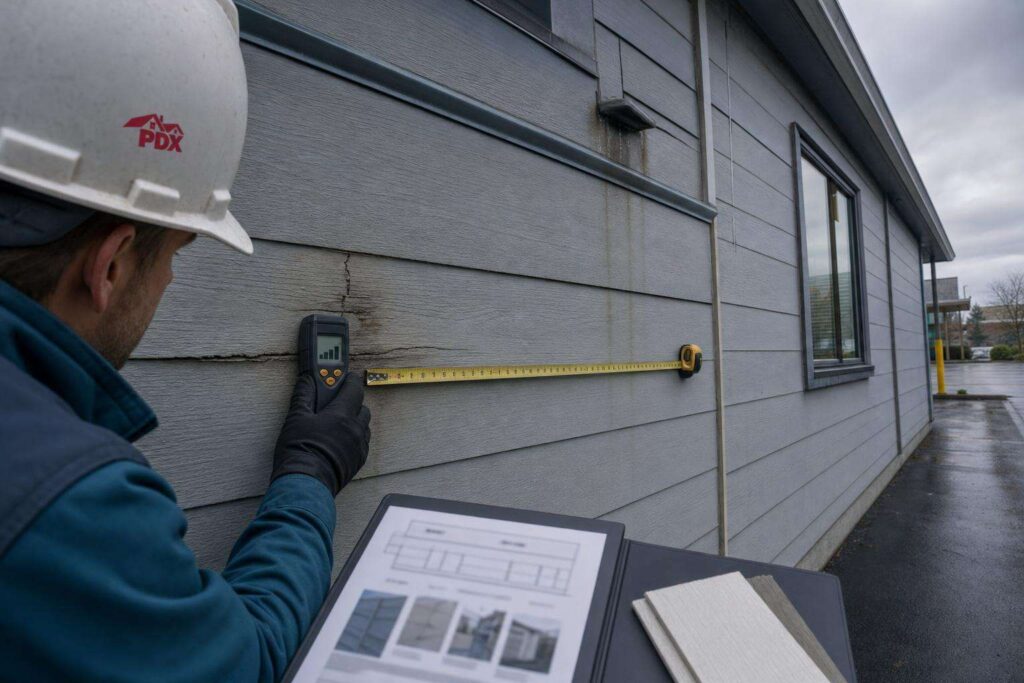
A commercial siding elevation audit is a structured review of one or more exterior wall faces. Instead of looking only at the damaged area, the contractor evaluates the full elevation from top to bottom and side to side.
The audit may include visual inspection, documentation, moisture-related observations, photos, measurements, and notes about access, tenant impacts, and adjacent roof or flashing conditions. For buildings with mixed exterior systems, the review may also consider how roofing materials, wall transitions, and penetrations work together.
Common items reviewed during the audit
- Visible cracks, gaps, impact damage, or panel movement
- Failed sealant joints around windows, doors, vents, and penetrations
- Water staining, swelling, soft spots, or delamination
- Clearance from grade, paving, balconies, or rooflines
- Flashing conditions at horizontal transitions
- Fastener patterns and signs of movement
- Compatibility of existing siding with proposed patch materials
- Tenant entrances, signage, equipment, and access constraints
Why Patch Repairs Should Not Be Approved Too Quickly
A patch may look efficient on paper, but it can create problems when the surrounding siding is aged, moisture-affected, discontinued, or installed in a way that makes clean tie-ins difficult. A patch repair should be based on the condition of the wall assembly, not only the size of the damaged area.
For example, fiber cement siding can perform well in the Northwest when installed and maintained correctly, but patching it without reviewing clearances, flashing, and adjacent boards can leave the underlying problem unresolved. The same is true for other commercial siding systems where water movement, improper terminations, or sealant failure may be part of the issue.
Risks of approving a patch without an audit
- The repair may not address the cause of water intrusion.
- New materials may not align well with older siding profiles or finishes.
- Hidden deterioration may remain behind the patched area.
- Tenant disruption may increase if the area must be reopened later.
- Budget planning becomes harder when related conditions are missed.
How Elevation Audits Help Property Managers Make Better Decisions
Commercial exterior decisions often involve budgets, tenant schedules, insurance questions, lease obligations, and long-term maintenance planning. An elevation audit gives decision-makers a clearer basis for approving the right scope.
Instead of asking, “Can this spot be patched?” the better question is, “What does this elevation need to perform properly?” Sometimes the answer is a targeted repair. Other times, the audit may point to a larger siding replacement scope, phased work, or coordination with roof repair and drainage improvements.
Good audit documentation should support
- Clear repair recommendations
- Photo documentation of observed conditions
- Identification of related roof, flashing, or drainage concerns
- Tenant access and safety planning
- Prioritization of urgent versus planned work
- More accurate comparison between patch repair and replacement options
When Roof Conditions Should Be Reviewed at the Same Time
Commercial siding problems are often connected to water movement from above. A roof edge, scupper, gutter, parapet, balcony, or wall-to-roof transition may contribute to staining or siding deterioration below. For this reason, it can be helpful to involve a Portland roofing contractor that understands both siding and roofing systems.
If the building also needs roof repair, emergency roof repair planning, roof installation, or evaluation of asphalt shingle roofing on connected structures, the exterior scope should be coordinated. A licensed roofing company can help property teams review how the roof and siding interact before approving work that only solves part of the problem.
Patch Repair, Partial Replacement, or Full Siding Replacement?
The right recommendation depends on the condition of the elevation, the siding material, access, moisture exposure, and the building owner’s long-term plan. A well-documented audit helps sort the options.
Patch repair may be appropriate when
- Damage is isolated and the surrounding siding is stable.
- The source of damage is known and can be corrected.
- Matching or compatible materials are available.
- Flashing and moisture management details remain sound.
Partial siding replacement may be appropriate when
- Damage extends across a defined section of the wall.
- Multiple boards, panels, or trim pieces have failed.
- The repair needs better tie-ins at corners, openings, or transitions.
- The property team wants a cleaner, longer-lasting exterior scope for that elevation.
Full elevation replacement may be appropriate when
- Failures are widespread across the wall face.
- Moisture-related deterioration is visible in several areas.
- Existing siding is near the end of its service life.
- Material matching would leave an uneven appearance.
- The project is part of broader home exterior upgrades or commercial exterior improvements.
Special Considerations for Occupied Commercial Buildings
Tenant-occupied properties require careful planning. Even a small siding repair can affect entrances, parking, signage, outdoor seating, loading zones, or customer access. An elevation audit helps identify these conditions before the scope is approved.
This is especially important for retail centers, offices, mixed-use buildings, medical spaces, and multi-tenant properties where disruption needs to be managed responsibly. The audit can help clarify work areas, timing, access equipment needs, and communication points for tenants.
Questions to address before approving work
- Will any tenant entrances or walkways be affected?
- Are there signs, lights, cameras, vents, or awnings attached to the siding?
- Will work require lift access, scaffolding, or temporary protection?
- Are there business hours or delivery schedules to consider?
- Does the repair area connect to roof drainage or upper-level water paths?
What to Expect from Pdx roofing and siding
Pdx roofing and siding provides direct, practical guidance for exterior repair and replacement decisions in Portland, OR, and the Portland Metro area. Whether the building needs siding repair, siding replacement, roof repair, or coordinated roof installation planning, the goal is to help you understand the condition first and approve the right scope with confidence.
For commercial siding patch requests, an elevation-first approach helps reduce guesswork and supports a more reliable repair plan. Services and offers are subject to availability and approval.
Plan the Right Exterior Repair Before You Approve the Patch
If your commercial building has visible siding damage, staining, loose materials, or recurring moisture concerns, schedule an exterior review before moving forward with a patch repair. Pdx roofing and siding can help evaluate the elevation, document the conditions, and recommend a practical next step. For practical next steps, Call roof installation now and talk with the team about timing, scope, and the right path for your situation.