


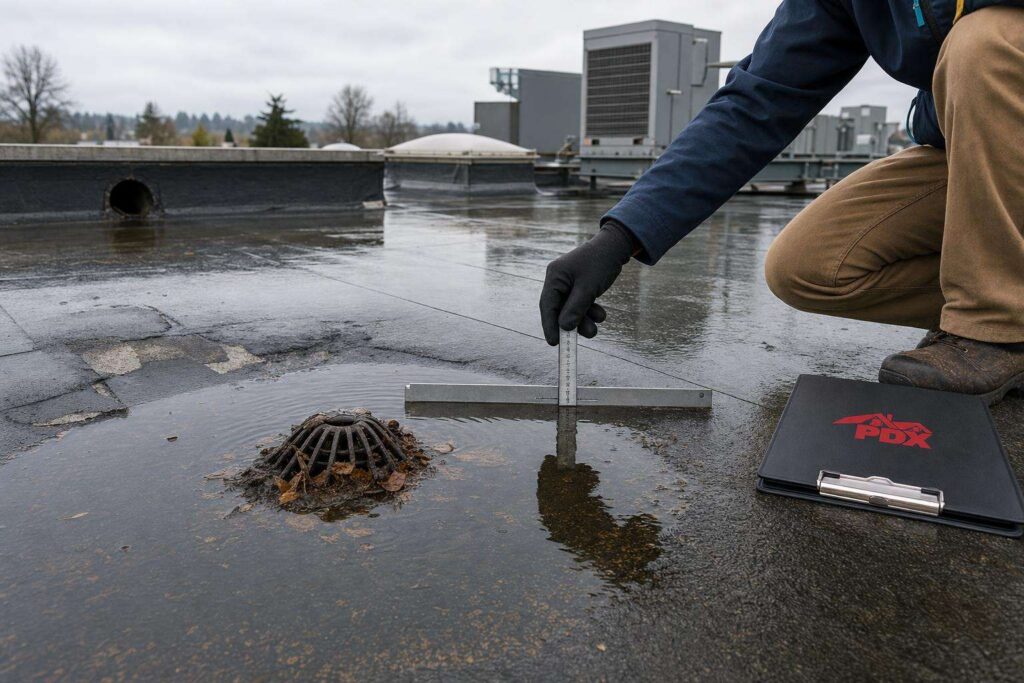
Recurring Ponding Is a Roof Performance Warning
Water that remains on a commercial roof after rainfall deserves attention, especially in the Portland Metro area where long wet seasons can test drainage systems. A single isolated puddle may be manageable, but recurring ponding can point to slope problems, clogged drainage, saturated insulation, membrane fatigue, or structural movement.
For building owners, facility managers, and tenants, the key question is practical: does the roof need a defined repair scope, or is ponding a signal that replacement planning should begin? The honest answer depends on what is causing the water to stay in place and how much damage has already occurred below the surface.
Why Ponding Happens on Commercial Roofs
Commercial low-slope roofs are designed to move water toward drains, scuppers, or gutters. When that movement is interrupted, water collects in low areas. Common causes include:
- Blocked drains or scuppers: Debris, leaves, and sediment can slow drainage and create standing water.
- Insufficient slope: Some roofs were not built with enough pitch, or the slope has changed over time.
- Sagging deck areas: Structural deflection can create depressions where water repeatedly gathers.
- Compressed or saturated insulation: Wet insulation can lose shape and create low spots under the membrane.
- Past repair buildup: Multiple layers of patching or coating can alter water flow.
- HVAC or rooftop equipment impacts: Equipment installation and service traffic can disturb drainage paths.
A licensed roofing company should evaluate the roof system as a whole rather than treating ponding as only a surface issue.
When Ponding May Be a Repair Scope
Recurring ponding does not automatically mean the roof must be replaced. In some cases, a focused roof repair plan can restore drainage and reduce risk. Repair may be appropriate when the roof membrane is generally serviceable, seams are intact, insulation is dry, and the ponding source is localized.
Common repair-focused solutions
- Clearing and testing drains, scuppers, and downspouts
- Repairing open seams, punctures, or flashing defects around ponding areas
- Adding tapered insulation in limited areas to improve water flow
- Correcting localized depressions where feasible
- Improving drainage at parapet walls or roof edges
- Documenting the repair area for future maintenance tracking
A repair scope should be specific. It should identify the cause of ponding, the affected roof zones, the roofing materials involved, and any limitations. If the repair only addresses the symptom while the roof continues to hold water in the same locations, the underlying problem may remain.
When Ponding May Point to Replacement
Replacement becomes a stronger consideration when ponding is widespread, returns soon after repairs, or is paired with deeper system deterioration. In Portland and OR weather conditions, repeated moisture exposure can accelerate problems in vulnerable roof assemblies.
Replacement signals to take seriously
- Water remains in multiple areas after typical drainage time
- Leaks recur despite prior roof repair work
- Insulation is wet, compressed, or uneven across large sections
- The membrane is brittle, blistered, split, or pulling at seams
- Flashing failures are present at curbs, walls, or penetrations
- The roof has a long repair history with diminishing results
- Structural slope or deck movement is contributing to low areas
In these situations, another patch may not be the responsible recommendation. A replacement approach can allow the roofing contractor to correct slope, replace compromised materials, improve drainage design, and install a roof system better suited to the building’s use.
Inspection Should Come Before the Decision
The right decision starts with a careful roof assessment. A Portland roofing contractor should review more than the visible puddles. Useful inspection steps may include:
- Mapping ponding locations after rain
- Checking drains, scuppers, gutters, and overflow routes
- Inspecting membrane seams, flashing, penetrations, and roof edges
- Looking for signs of trapped moisture or insulation movement
- Reviewing prior service records and leak history
- Assessing whether rooftop equipment affects water flow
- Coordinating further evaluation when structural concerns are suspected
For occupied commercial buildings, communication matters. If tenants are reporting ceiling stains, odors, or recurring leaks, those reports should be included in the evaluation. Tenant feedback can help identify patterns that are not obvious during a dry roof visit.
How Repair Scope and Replacement Planning Differ
A repair scope is typically built around correcting a defined issue. It should explain what will be repaired, which materials will be used, and what conditions are outside the scope. This is appropriate when the roof still has reliable service life and the ponding source is limited.
Replacement planning is broader. It considers roof installation design, drainage layout, insulation strategy, membrane selection, access needs, and how work will affect occupants. It may also be a good time to review related building envelope needs, such as siding replacement, fiber cement siding, asphalt shingle roofing on adjacent structures, or other home exterior upgrades for mixed-use or multi-building properties.
The best recommendation is not always the largest project. It is the option that addresses the cause, manages risk, and aligns with the condition of the roof.
When to Treat Ponding as Urgent
Some ponding issues can be scheduled for evaluation, while others need faster attention. Contact a roofing professional promptly if you notice active interior leaking, ceiling staining, water near electrical systems, sagging roof areas, or a sudden increase in ponding after a storm. If water intrusion is active, emergency roof repair may be needed to stabilize the situation before a long-term plan is developed.
Delaying evaluation can make it harder to separate a manageable repair from a larger replacement need. Documentation, photos, and timely inspection help building owners make better decisions.
Work With Pdx Roofing and Siding
Pdx roofing and siding provides direct, knowledgeable guidance for roof repair, roof installation, and exterior improvement needs in Portland, OR, and the Portland Metro area. If recurring ponding is creating uncertainty at your commercial property, our team can help evaluate the roof condition and discuss practical next steps.
Services and offers are subject to availability and approval. For practical next steps, Call roof installation now and talk with the team about timing, scope, and the right path for your situation.