


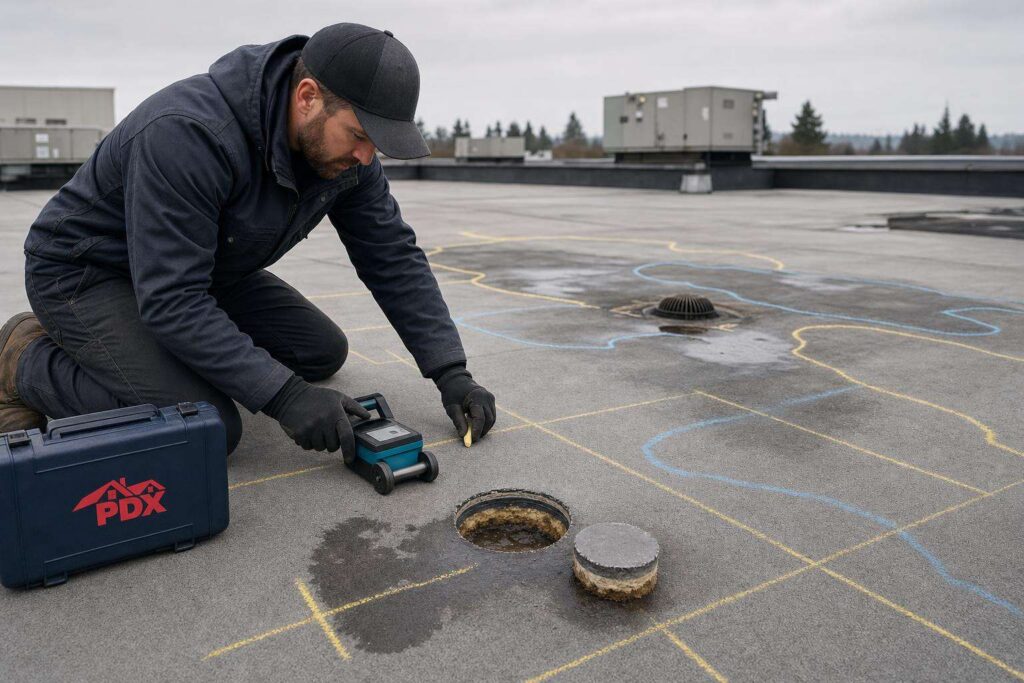
Why Moisture Mapping Matters for Commercial Roofs
Commercial roof problems are not always visible from the surface. A membrane can look mostly intact while insulation, decking, or roof layers underneath are holding moisture. For property owners and managers in Portland and the Portland Metro area, moisture mapping can provide valuable guidance before choosing between roof repair, roof installation, or full replacement.
At PDX Roofing and Siding, we believe in honest guidance. Moisture mapping helps support better decisions by showing where wet areas may exist, how far the issue may extend, and whether targeted repair or broader replacement is the more practical path.
What Is Moisture Mapping?
Moisture mapping is the process of identifying and documenting areas of suspected trapped moisture within a commercial roof assembly. It is commonly used on low-slope and flat roof systems where leaks may travel below the membrane before showing up inside the building.
A moisture map can help show:
- Areas where insulation may be saturated
- Potential leak pathways beneath the roof surface
- Sections that may need core sampling or further inspection
- Whether damage appears isolated or widespread
- Where roof repair may be appropriate versus replacement
Common Moisture Mapping Methods
Different roof systems require different inspection methods. A licensed roofing company may recommend one or more of the following approaches depending on the roof type, roofing materials, weather conditions, and site access.
Infrared Roof Scanning
Infrared scanning looks for temperature differences across the roof surface. Wet insulation often retains heat differently than dry areas, which can make suspicious zones visible during the right conditions. This method is useful for identifying areas that may require closer evaluation.
Capacitance Testing
Capacitance meters can help detect potential moisture below the membrane by measuring electrical properties in the roof assembly. This method is often used to compare readings across different roof sections.
Nuclear Moisture Testing
Nuclear testing is another specialized method used by trained professionals to assess moisture presence in certain roof systems. It requires proper handling, licensing, and interpretation.
Core Cuts and Verification
Moisture mapping is most useful when suspicious findings are verified. A contractor may recommend core cuts in selected areas to confirm roof composition, insulation condition, and actual moisture presence. Core cuts should be properly patched after inspection.
How Moisture Mapping Supports Repair vs. Replacement Decisions
Without moisture mapping, it can be difficult to know whether a leak is isolated or part of a larger roof system failure. Mapping helps commercial property owners avoid making decisions based only on visible symptoms.
The results may support:
- Targeted roof repair: If moisture is limited to a small area and the surrounding roof is performing well.
- Partial replacement: If certain roof sections are compromised while others remain serviceable.
- Full roof replacement: If moisture is widespread, insulation is saturated, or the roof is near the end of its usable service life.
- Maintenance planning: If the roof is mostly dry but has vulnerable penetrations, seams, drains, or flashing details.
For Portland commercial buildings, this is especially important because recurring rain, shaded roof areas, and drainage issues can make moisture problems harder to track without a structured inspection process.
When to Consider Moisture Mapping
Moisture mapping may be worth considering when:
- Your building has recurring ceiling stains or interior leaks
- You are planning a roof replacement and want a clearer scope of work
- You need documentation before budgeting for capital improvements
- You are evaluating storm damage or emergency roof repair needs
- Your roof has ponding water, membrane blisters, soft spots, or repeated seam failures
- You are buying, selling, or managing a commercial property and need roof condition insight
What Moisture Mapping Can and Cannot Tell You
Moisture mapping is a decision-making tool, not a stand-alone guarantee. It can identify suspicious areas and help guide next steps, but findings should be interpreted alongside visual inspection, drainage review, roof age, maintenance history, and verification testing.
A professional evaluation may also consider:
- Roof membrane type and condition
- Flashing, curb, and penetration details
- Drainage layout and ponding patterns
- Deck condition and structural concerns
- Compatibility of existing roofing materials with repair options
Why Work With a Portland Roofing Contractor
A knowledgeable Portland roofing contractor understands how local weather patterns, building design, and roof drainage affect long-term performance. PDX Roofing and Siding helps property owners evaluate roofing concerns with practical recommendations rather than one-size-fits-all answers.
In addition to commercial roof repair and roof installation guidance, our team supports exterior improvement planning, including siding replacement, siding repair, fiber cement siding, asphalt shingle roofing, and other home exterior upgrades for properties throughout Portland, OR and the Portland Metro area.
Plan the Right Next Step for Your Roof
If you are unsure whether your commercial roof needs repair, maintenance, partial replacement, or a full replacement, moisture mapping can help clarify the scope before major work begins. PDX Roofing and Siding can help you review your roof concerns and determine the most practical next step based on the condition of your property.
Services and offers are subject to availability and approval. For practical next steps, Call roof installation now and talk with the team about timing, scope, and the right path for your situation.